
The promise of triple-digit APYs draws thousands of investors into DeFi protocols every day. But behind those eye-catching numbers lies a minefield of smart contract vulnerabilities, impermanent loss, and rug pulls that have cost the community billions.
The good news? You don’t need to gamble your capital to earn meaningful returns from yield farming.
Successful yield farming balances opportunity with protection. This guide covers seven battle-tested strategies that intermediate and advanced DeFi participants use to generate consistent returns while managing exposure to smart contract risk, impermanent loss, and market volatility. You’ll learn protocol selection criteria, position sizing frameworks, and optimization techniques that work across market conditions.
Understanding the yield farming landscape in 2024
Yield farming has matured significantly since the DeFi summer of 2020. What started as simple liquidity mining programs has evolved into a sophisticated ecosystem of lending protocols, automated market makers, and yield aggregators.
The core mechanics remain straightforward. You deposit crypto assets into a protocol. That protocol uses your capital to facilitate trading, lending, or other financial services. In return, you earn a portion of the fees plus potential token incentives.
But the devil lives in the details.
Annual percentage yield (APY) represents your total return including compound interest. Annual percentage rate (APR) shows simple interest without compounding. A protocol advertising 100% APY might only offer 69.3% APR, a meaningful difference over time.
Smart contract risk affects every DeFi position. Even audited protocols can harbor bugs that drain funds. Protocol governance decisions can change fee structures overnight. Token incentives that boost yields today might evaporate tomorrow.
Understanding blockchain nodes helps you evaluate the decentralization and security of protocols you’re considering.
Strategy one: stablecoin liquidity pools on established DEXs
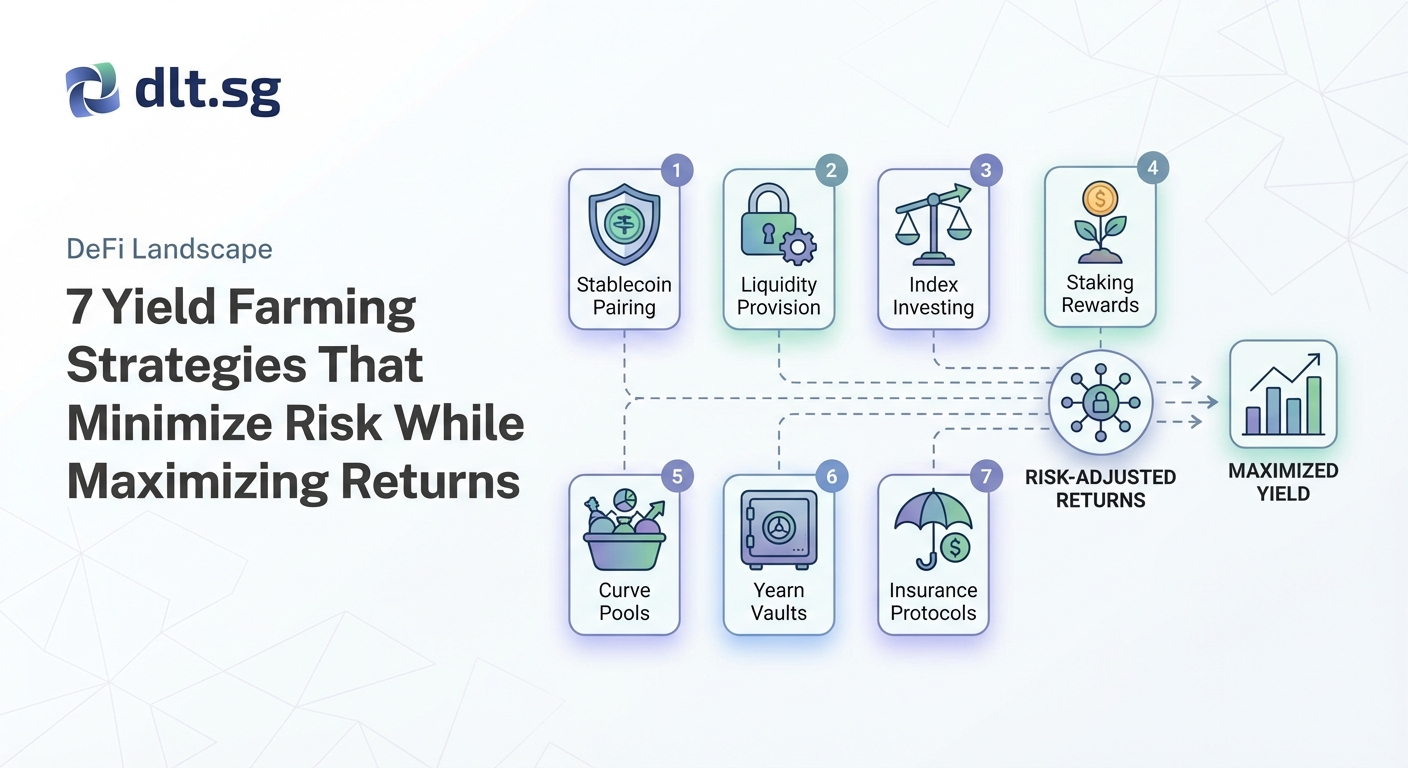
Providing liquidity to stablecoin pairs offers the most conservative entry point into yield farming.
The approach is simple:
- Select a pair like USDC/USDT or DAI/USDC on a proven decentralized exchange
- Deposit equal values of both stablecoins to receive LP tokens
- Stake those LP tokens to earn trading fees plus potential incentives
- Monitor pool dynamics and rebalance as needed
Stablecoin pairs minimize impermanent loss because both assets maintain similar values. When USDC trades at $1.00 and USDT trades at $0.999, the price divergence barely impacts your position.
Current yields on major platforms range from 3% to 15% APY depending on trading volume and incentive programs. That might seem modest compared to triple-digit returns elsewhere, but your capital stays relatively protected.
Risk factors to monitor:
- Smart contract vulnerabilities in the DEX protocol
- Stablecoin de-pegging events (remember UST?)
- Changes to incentive programs that reduce yields
- Network congestion that makes rebalancing expensive
Focus on protocols with multiple audits, long track records, and substantial total value locked. Curve Finance, Uniswap V3, and Balancer represent the gold standard for stablecoin farming.
Strategy two: single-sided staking with blue-chip tokens
Single-sided staking removes impermanent loss from the equation entirely.
You deposit one asset into a staking contract. The protocol locks your tokens and distributes rewards from fees, inflation, or both. Your position value moves only with the underlying asset price.
Ethereum staking through Lido or Rocket Pool offers 3-5% APY with minimal smart contract risk. Your ETH generates rewards while maintaining full exposure to price appreciation.
Layer-2 protocols often incentivize staking their native governance tokens. Arbitrum, Optimism, and Polygon offer programs that reward long-term holders while supporting network security.
The process works like this:
- Choose a protocol with strong fundamentals and real usage
- Deposit tokens into the staking contract
- Receive derivative tokens representing your staked position
- Earn staking rewards automatically
- Unstake when you want to exit (subject to unlock periods)
Compare this to providing liquidity in a volatile pair. If you deposit ETH and USDC into a pool, then ETH doubles in price, you’ll have more USDC and less ETH than if you’d simply held. That’s impermanent loss. Single-sided staking avoids this entirely.
The tradeoff? Lower yields. You’re sacrificing potential returns for capital preservation and simplicity.
Strategy three: leveraged farming through money markets
Sophisticated farmers use lending protocols to multiply their exposure and yields.
Here’s the basic loop:
- Deposit USDC as collateral on Aave or Compound
- Borrow another stablecoin against that collateral
- Deposit the borrowed asset into a high-yield pool
- Use those earnings to service the borrow interest
- Pocket the difference as profit
If you can borrow USDT at 4% and farm it at 12%, you’re earning an 8% spread on borrowed capital. Apply this to $100,000 in collateral with 3x leverage, and you’re generating returns on $300,000 of deployed capital.
The risks scale proportionally.
Liquidation becomes your primary concern. If your collateral value drops or borrow rates spike, the protocol will automatically sell your position to protect lenders. Maintaining a conservative health factor (ideally above 2.0) provides buffer against volatility.
How smart contracts actually execute on the Ethereum Virtual Machine helps you understand the mechanics protecting your leveraged positions.
Monitor these metrics daily:
- Current health factor across all positions
- Borrow rate trends on your debt
- Collateral asset volatility
- Yield sustainability on farming positions
Leveraged strategies demand active management. Set price alerts. Check positions daily. Have a plan for rapid deleveraging if market conditions shift.
Strategy four: yield aggregators for hands-off optimization
Yield aggregators automatically move your capital between protocols to maximize returns.
Yearn Finance pioneered this model. You deposit assets into a vault. The vault’s strategy contract evaluates dozens of farming opportunities, calculates optimal allocations, and rebalances positions to capture the best risk-adjusted yields.
Benefits include:
- Professional strategy development and testing
- Automated compounding that saves gas fees
- Diversification across multiple protocols
- Access to complex strategies without technical knowledge
The aggregator takes a performance fee, typically 10-20% of profits. That might seem steep, but the time savings and optimization often justify the cost.
Beefy Finance, Harvest, and Convex offer similar services across multiple chains. Each specializes in different asset types and risk profiles.
Before depositing into any aggregator:
- Review the vault’s historical performance
- Understand the underlying strategy
- Check smart contract audits
- Verify the protocol’s insurance coverage
- Assess the team’s track record
Some vaults pursue aggressive strategies with significant smart contract risk. Others focus on stable, conservative approaches. Match the vault’s risk profile to your tolerance.
Strategy five: cross-chain yield optimization
Different blockchain networks offer vastly different yields for similar strategies.
A USDC/USDT pool might earn 5% on Ethereum mainnet but 15% on Arbitrum or Optimism. The same stablecoin lending strategy could yield 8% on Avalanche versus 4% on Polygon.
Smart farmers bridge assets to capture these arbitrage opportunities.
The workflow:
- Identify yield differentials across chains
- Bridge capital using trusted services like Stargate or Synapse
- Deploy farming strategies on the higher-yield chain
- Monitor for shifting opportunities
- Rebalance across chains as yields change
Each bridge transaction carries risk. Smart contract vulnerabilities, delayed transfers, and bridging fees all eat into returns. Calculate the breakeven period before moving capital.
Building cross-chain smart contracts explores the infrastructure enabling these multi-chain strategies.
Focus on chains with strong security track records and substantial liquidity. Ethereum Layer-2s like Arbitrum and Optimism inherit mainnet security while offering lower fees. Alternative Layer-1s like Avalanche and Fantom provide different risk/reward profiles.
Track gas costs carefully. A strategy earning an extra 5% APY means nothing if bridging and transaction fees consume 3% of your capital.
Strategy six: delta-neutral farming to eliminate price risk
Delta-neutral strategies let you farm volatile pairs without directional exposure.
The concept: match a long position with an equal short position to neutralize price movements.
Here’s a practical example:
- Deposit ETH into a lending protocol as collateral
- Borrow USDC against that ETH
- Use the USDC to buy more ETH
- Provide the ETH/USDC pair as liquidity
- Short ETH perpetual futures to hedge price exposure
If ETH rises, your long exposure gains while your short loses. If ETH falls, the opposite occurs. The positions offset, leaving you with farming rewards minus borrowing costs and funding rates.
This strategy requires constant monitoring. Funding rates on perpetual contracts fluctuate based on market sentiment. Positive funding drains your short position. Negative funding pays you to hold shorts.
Calculate your all-in cost:
- Borrow interest on the loan
- Funding rates on the perpetual short
- Trading fees for opening positions
- Gas costs for maintenance
Subtract these from your farming APY. If you’re left with a positive return and can manage the complexity, delta-neutral farming provides steady income regardless of market direction.
Strategy seven: protocol-specific incentive programs
New protocols and established platforms regularly launch incentive programs to bootstrap liquidity.
These campaigns offer outsized returns for limited periods. A new DEX might pay 200% APY in native tokens to early liquidity providers. An established lending protocol might triple rewards on specific asset pairs to increase adoption.
The opportunity is real. Early participants in successful protocols have generated life-changing returns.
The risks are equally significant:
- Token price volatility that erases paper gains
- Mercenary capital that exits when incentives end
- Protocol failures that lock or lose deposits
- Regulatory uncertainty around new tokens
Approach incentive programs with strict position sizing. Risk only capital you can afford to lose completely. Take profits regularly rather than letting everything ride on token appreciation.
“The farmers who survive multiple cycles don’t chase every new opportunity. They size positions appropriately, diversify across strategies, and take profits systematically. Discipline beats conviction every time.”
Research the team, technology, and market need before deploying capital. Are your DeFi protocols compliant with regional regulations? Does the protocol solve a real problem? Can the token economics sustain long-term value?
Comparing strategies across key dimensions
| Strategy | Typical APY | Complexity | Primary Risk | Time Commitment |
|---|---|---|---|---|
| Stablecoin pools | 3-15% | Low | Smart contract | Weekly checks |
| Single-sided staking | 3-8% | Low | Token price | Monthly reviews |
| Leveraged farming | 15-50% | High | Liquidation | Daily monitoring |
| Yield aggregators | 8-25% | Medium | Aggregator risk | Monthly reviews |
| Cross-chain optimization | 10-30% | High | Bridge security | Weekly rebalancing |
| Delta-neutral | 5-20% | Very high | Funding rates | Daily adjustments |
| Incentive programs | 50-300% | Medium | Token volatility | Daily monitoring |
Risk management frameworks that actually work
Position sizing determines long-term survival more than strategy selection.
Allocate capital using a tiered approach:
Tier 1 (50-60% of farming capital): Conservative strategies on battle-tested protocols. Stablecoin pools on Curve. ETH staking through Lido. These positions prioritize capital preservation over maximum yields.
Tier 2 (30-40% of farming capital): Moderate-risk strategies with proven track records. Yield aggregators on established vaults. Blue-chip token staking. Single-sided positions on major protocols.
Tier 3 (10-20% of farming capital): Aggressive strategies and new opportunities. Leveraged positions with careful monitoring. New protocol incentives after thorough research. Cross-chain optimization for yield arbitrage.
Never deploy your entire portfolio into a single strategy or protocol. The DeFi landscape changes rapidly. Protocols that seem bulletproof can fail overnight.
Implement circuit breakers:
- Set maximum loss thresholds for each position
- Define conditions that trigger automatic exits
- Maintain emergency liquidity for rapid response
- Review positions weekly minimum
Gas optimization techniques help you preserve more of your farming returns by reducing transaction costs.
Insurance products like Nexus Mutual provide coverage against smart contract failures. The premiums reduce net yields but offer peace of mind on larger positions.
Common mistakes that destroy returns
Even experienced farmers make errors that erode profits:
Chasing yields without understanding risks: A 500% APY means nothing if the underlying token crashes 90% or the protocol gets exploited. Always understand where yields originate.
Ignoring gas costs: Claiming rewards daily might seem optimal, but if you’re paying $50 in gas to claim $30 in tokens, you’re losing money. Calculate breakeven periods for compounding.
Over-leveraging positions: That extra 2x leverage might boost returns by 20%, but it also doubles your liquidation risk. Conservative leverage ratios help you survive volatility.
Neglecting tax implications: Every swap, claim, and harvest creates a taxable event in most jurisdictions. The complete guide to crypto tax obligations covers reporting requirements for Singapore-based investors.
Failing to diversify protocols: Concentrating everything in one ecosystem multiplies your risk. If that chain suffers an outage or exploit, your entire farming operation stops.
Treating APY as guaranteed: Advertised yields reflect current conditions. They change constantly based on liquidity, trading volume, and incentive programs. Yesterday’s 100% APY might be today’s 30% APY.
Tools and resources for tracking performance
Effective farming requires monitoring multiple positions across various protocols and chains.
Portfolio trackers like DeBank and Zapper aggregate positions into unified dashboards. You can view total value, current yields, and historical performance across your entire farming operation.
DeFi Llama provides protocol-level data including total value locked, yield trends, and security audits. Use it to identify sustainable yields versus temporary incentive pumps.
Gas trackers like Blocknative help you time transactions for minimum fees. Claiming rewards during low-activity periods can save 50-70% on transaction costs.
Set up monitoring alerts:
- Price movements that affect liquidation risk
- Yield changes on active positions
- Smart contract events on protocols you use
- Governance proposals that might impact returns
Maintain detailed records of every transaction. Your future self (and tax accountant) will thank you.
Building sustainable farming practices
The most successful yield farmers treat it like a business, not a lottery ticket.
They develop repeatable processes:
- Weekly position reviews and rebalancing
- Monthly strategy assessment and adjustment
- Quarterly deep research on new opportunities
- Annual tax planning and optimization
They take profits systematically rather than letting everything compound indefinitely. A common approach: withdraw 50% of profits monthly, reinvest the other 50% to grow positions.
They stay educated on protocol developments, security practices, and market trends. How automated market makers actually work behind the scenes helps you understand the mechanics generating your yields.
They participate in protocol governance when holding native tokens. Voting rights give you influence over fee structures, incentive programs, and security measures that directly impact your returns.
Most importantly, they remain adaptable. Strategies that worked brilliantly in 2023 might underperform in 2024 as market conditions evolve. Rigid adherence to outdated approaches guarantees suboptimal results.
Making yield farming work for your situation
These seven strategies provide a framework, not a prescription. Your optimal approach depends on capital size, risk tolerance, time availability, and technical expertise.
Smaller portfolios benefit from yield aggregators that provide diversification and professional management without requiring constant attention. Larger portfolios justify the time investment for active optimization across multiple strategies and chains.
Risk-averse farmers should emphasize stablecoin strategies and single-sided staking. Aggressive farmers might allocate more to leveraged positions and new incentive programs.
Technical experts can implement complex delta-neutral strategies and cross-chain optimization. Less technical participants might prefer simpler approaches through established aggregators.
The key is matching strategy to capability. A sophisticated strategy you don’t understand will likely lose money. A simple strategy you execute consistently will probably profit.
Start small. Test strategies with amounts you’re comfortable losing. Scale successful approaches gradually as you gain experience and confidence.
The DeFi ecosystem rewards patience, discipline, and continuous learning. Master one strategy before adding another. Build your farming operation methodically rather than trying to implement everything simultaneously.
Your yields might not match the eye-popping numbers promoted on social media. But sustainable, risk-managed returns compound into meaningful wealth over time. That’s the real opportunity in yield farming.